Breaking Free from the Social Media Feed: Introducing the Feed Escape Guide

Final Assignment for CEID100

https://feed-escape-guide.vercel.app/

In today’s digital age, scrolling through social media feeds has become an almost automatic habit. But behind the endless likes and posts lies a carefully designed system that keeps users hooked often at the cost of their mental health and well-being.

Our final project for the CEID100 course, the Feed Escape Guide, is an app created to shed light on how social media traps users in a cycle of endless scrolling and validation seeking. The app explores the psychological effects of social media, revealing how algorithms manipulate attention and emotions to keep us engaged longer than we realize.

More importantly, the Feed Escape Guide offers practical tools and strategies to help users recognize these patterns and regain control over their digital habits. It encourages setting boundaries and making intentional choices to use social media mindfully, rather than falling victim to its addictive design.

This project aims to empower users to escape the “feed trap” and reclaim their time, focus, and mental health. In a world dominated by constant digital noise, the Feed Escape Guide provides a necessary step towards a healthier relationship with social media.

Thankyou!

Best of CEID100- My top topics and tools

Here’s a visual recap of my favorite topics and tools from CEID100. It sums up all the cool stuff I learned and the digital skills I picked up!

https://create.piktochart.com/output/bac7f7af7422-ceid100

Thanks to CEID100 for introducing me to such topics and piquing my curiosity in the topics of UI/UX and many such more.

Learning to talk to Robots!

For this week’s assignment, we had to learn a course off CodeAcademy.

First off, let me start by saying how amazing the platform is. Super user friendly and a lot of free courses to learn.
I chose to learn the “Introduction to Chatgpt”, to understand what goes on behind, and how we can train AI to maximise performance.

There’s surprisingly, a lot of things that a simple AI model, our friendly chatbot- Chatgpt could do for us. Not only can it give you song recommendations to listen to while cooking, it goes way beyond that. From being your nutritionist, language teacher, mentor, brainstorm bestie, digital marketer, to customer service- it’s a long list.


What I Learned-

  • Chatgpt is way more than just a web browser screen you see on your phone. It’s complex, is built on various concepts like machine learning, NLP’s and collects vast data to suggest responses.
  • There is mathematics! The system runs on number of probabilities of getting the ‘right’ or ‘wrong’ answer.
  • Learn to talk to AI. The best way to get the best answers out, is to optimise your language to be concise and clear.

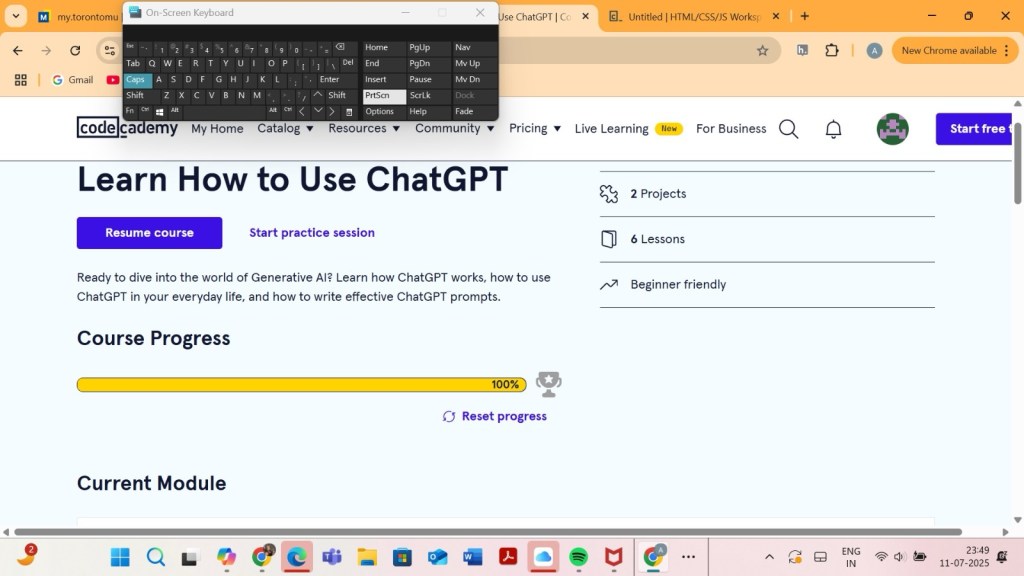
My course progress
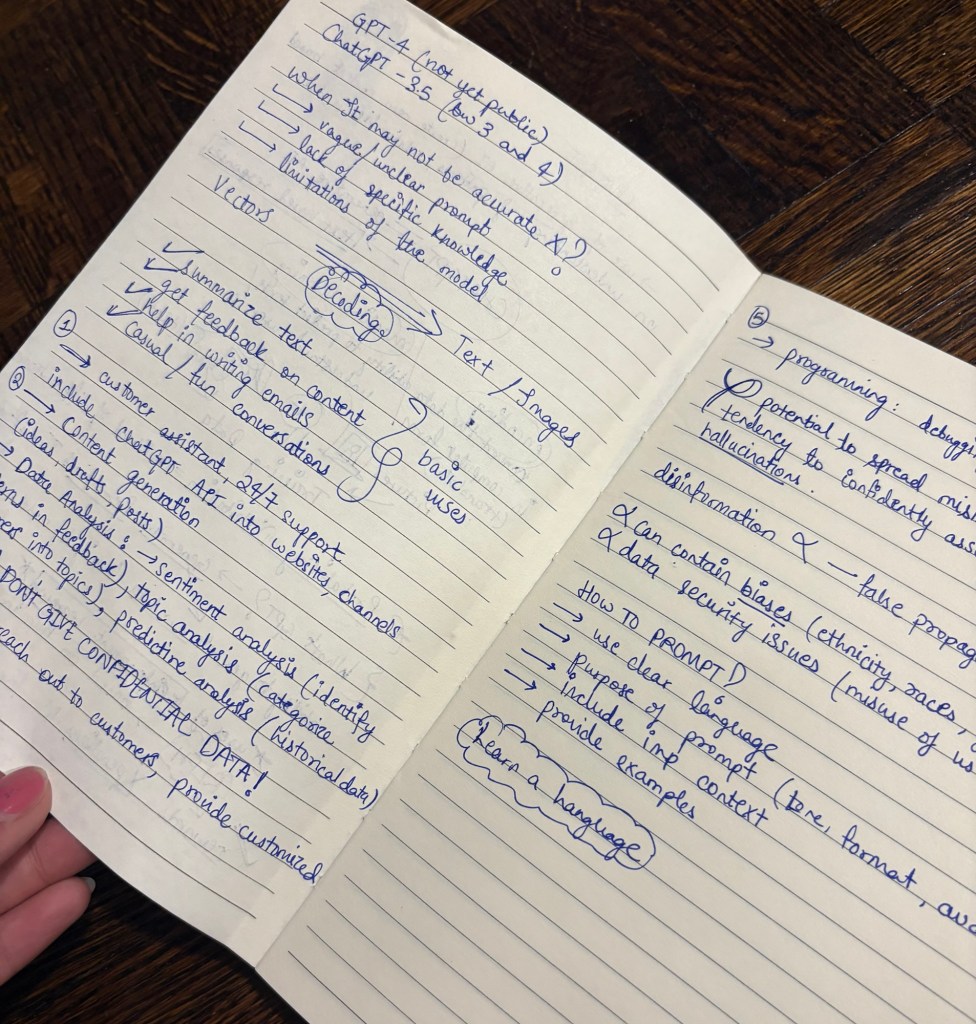
Real notes

Why It Was Worth It:

AI, is definitely the future. ChatGPT is one of the fastest growing AI network out there, and using it to learn and grow puts you in an advantage.

Now, I understand the different ways it could be used to perform efficiently. Everything- from copywriting, to making a graphic social media post, to getting a marketing strategy, is possible through AI.

One thing a mentor once told me stuck with me, and I’d like to share it- “AI is not the future, the people who know how to use is it, are the future”.

Just in Time

What is one social factor that people nowadays, increasingly fight with? Well, there is no one answer because there’s so many problems in socials, economical and technological aspects in today’s world.

One problem that I want to zoom the lens on, is that of procrastination. Avoidable, but not easy to overcome.

As a student, procrastination gets in the way of many things- assignments, examinations, managing school and work, chores and amidst all that, taking care of your health and wellbeing. To tackle that, I came up with the idea of integrating A.I. into an application called ‘Just in Time’.

Using A.I. and its tools like Predictive Analysis, Big Data, Machine Learning and Natural Language Processing (NLP’s), this app can be the one solution, your constant reminder, and expert mentor by providing solutions to your problems.

  1. Big Data- It is basically all your digital activity—searches, streaming, browsing you do online is collected in a huge and complex form. Typically, with the use of A.I., we will extract patterns of an individual, hidden in this big mass. This helps the app give smarter, more personalized suggestions.
  2. Machine Learning- It is a kind of technology that understands a user’s behaviour. Better understanding of you= better personalisation.
  3. Natural Language Processing (NLP)- to make it seem more friendlier and natural, and less robot-ish, NLP provides a human oriented way of communicating with the user. From offering motivational messages to check ins, to voice commands, the list goes on.

This app will be synced with user’s school account so that upon enrolment, all further class schedules, examinations, due dates for assessments, projects, etc., can be fed into the app. Moreover, if a student is working part time- their work schedule can also be put in to get the best benefit. Apart from these two, it will have a segment for household chores/groceries/laundry, one for healthy lifestyle (gym, nutrition), one for personal hobbies (art, music, gaming or sports), and many such segments built in, which will translate into a timetable and reminders in the form of friendly notifications.

AI isn’t just about tech—it’s about transforming everyday struggles into manageable routines. With Just In Time, the goal isn’t perfection. It’s progress, made personalized.

Misinformation

Here’s my 30-second Public Service Announcement on Misinformation — a topic we dove deep into this term.
I created + edited everything myself , used Creative Commons materials, and made sure it packs a punch 💥
From audio edits to digital visuals, this mini production is all about raising awareness and making you think.
Watch, reflect, and share if it hits 🫶

Fake news (misinformation)

Nova Cybersecurity Lab

Hello everybody.

For my assignment this week, I spent around 40 minutes playing the Nova Cybersecurity Lab game.

The game had three core challenges—Password Cracking, Coding, and Social Engineering—and each taught me something major.

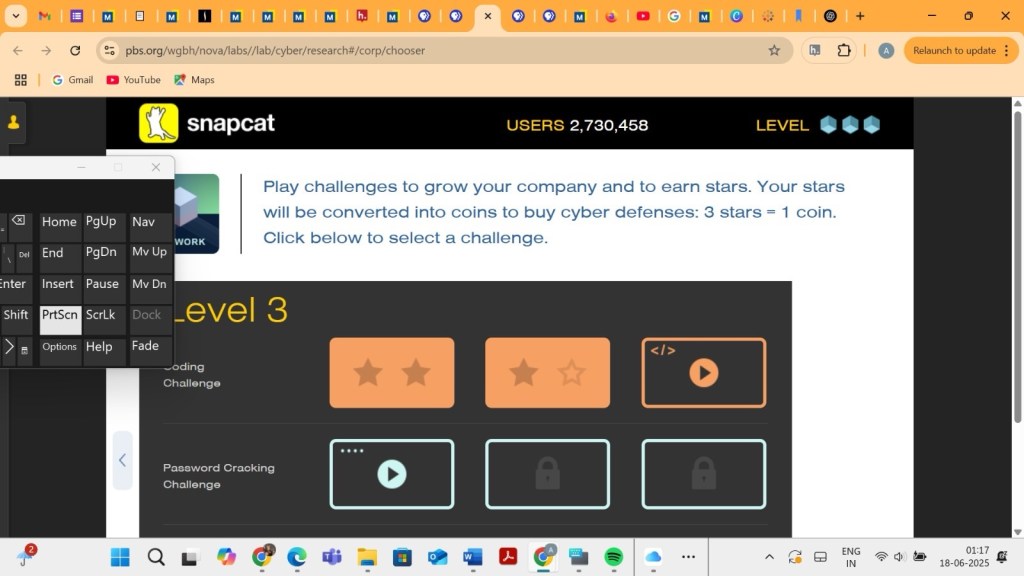
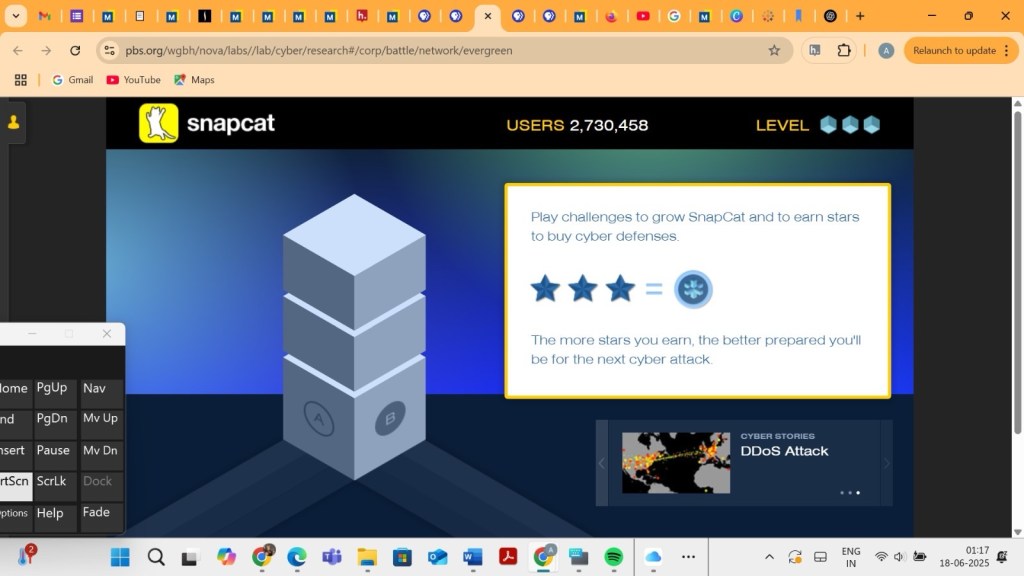
progress screenshots

Firstly, the Password Cracking challenge showed how weak passwords leave companies vulnerable to brute-force attacks. It reinforced the class concept of password entropy, where longer, randomized passwords boost security. A lot of the times, with short passwords (4-6words), companies can use software’s to easily crack it. Key takeaway- use a mix of numbers, words, symbols and characters to make it secure.

Then came the Coding challenge, which used drag‑and‑drop syntax to animate a character to move and do things. This showed me the importance of secure coding practices—every line of code matters in building resilient software, just like we learned when discussing secure development lifecycles in class.

Finally, the Social Engineering challenge asked me to identify phishing emails, scam websites, and suspicious calls and differentiate them. It emphasised how cybersecurity isn’t just tech—it’s also about human behavior and awareness—a concept we talked about through risk analysis and user-centric defenses.

Overall, the experience made cybersecurity feel real and urgent. I’ve got the screenshot proof, but this game gave me a new appreciation for how interconnected technical and human components truly are in defending online systems. How everything works together. How cyber security is so crucial today.


Fake News, Real Damage: What They Don’t Teach You About the Internet

So many types of disorders in the world- let’s talk about ‘Information Disorder’. Do you still believe everything you encounter online? Maybe now you won’t.

All those whatsapp forward messages, fake news on your feed and people panicking about something that doesn’t even exist, all change your perspective a lot.

As a part of our module, we’re going to deep dive into 3 categories- disinformation, misinformation and malinformation with the help of a few examples.

Let’s dig deeper-

Disinformation– Canada is Cancelling All Indian Student Visas

https://www.altnews.in/english/fact-check-canada-not-cancelling-visas-of-indian-students-due-to-fake-offer-letters/

This news blew up on Whatsapp and social media stating the mass cancellation of visas by Canada. Basically, it stands for sharing false information online deliberately just to draw attention or clicks. Some students were investigated, but there was no evidence of mass cancellation.
One should observe the lack of sources, the dramatic tone or graphics, and the lack of confirmation by higher authorities.

A good idea is to always check the IRCC website or official government websites for updates regarding the news.

Misinformation– COVID-19 Vaccines Cause Infertility

https://www.reuters.com/article/uk-factcheck-vaccine-fertility-idUSKBN2B42RS

This falsely claims that COVID vaccines cause infertility — and while it is not always shared with bad intentions (some people believed and showed concern), it’s still misinformation. It’s wrong info, but not always spread with the goal of harming.

Again, to fact check, make sure to verify from legitimate sources like WHO or Health Canada, before trusting it all.

Mal-information: Leaking Private Details of Indian Students in Immigration Scams

https://www.canada.ca/en/immigration-refugees-citizenship/services/protect-fraud.html

Scammers often post or circulate real personal info of international students (like names, application statuses, or even photos) to make fake IRCC scams seem legit. This is mal-information — info that’s based in truth, but shared with the intent to cause harm. These scams target people’s fear and urgency, especially during visa season.

For example, there are a lot of emails presenting fake job openings and interviews just to collect data too.

Always look out for sketchy emails, demands for money via WhatsApp, or leaked data without consent. Just because something includes real info doesn’t mean it’s being used ethically.

We live in a world where information is power — but also a weapon. As students (especially immigrants balancing two systems), we’re extra vulnerable to fake news and shady info traps.

Stay curious but also cautious.

What is AI? Why do we care?

Everybody knows that AI is taking over, and is the one thing the future holds for us (for better or for worse)?

Our group for our course CEID-100 decided to make a project presentation on the biggest, hottest, controversial and the deep topic of AI.

This is a project teaser or a proposal we created, debriefing what we will cover in our upcoming final presentation.

Super excited for this learning opportunity.

Through this project, we aim to not only share our opinions but also learn more about the whole situation ourselves. Dive deeper and prepare ourselves for the future of AI.

Social Media Presence: Make or break your brand

Welcome to the world of social media. Every brand or personality that wants to grow has to step into this ground. Here’s the catch- it can either build you or absolutely crush your reputation. With so many active followers and audience from around the world, it is a sure shot way to reach masses and communicate with them effectively, (and in an instant).

For today’s assignment, I’m zooming in on two brands that perfectly illustrate the module’s core ideas — the three I’s (infrastructure, interactivity, innovation) and the essentials of social branding and netiquettes.

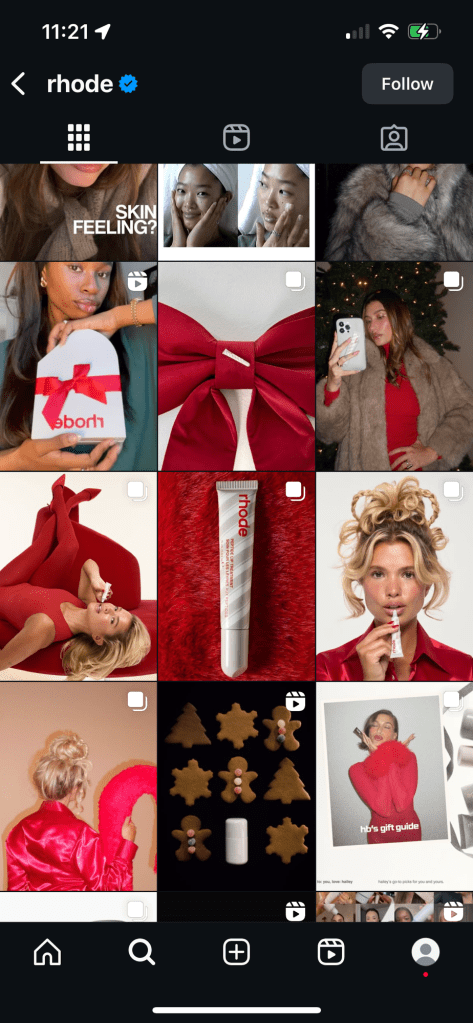
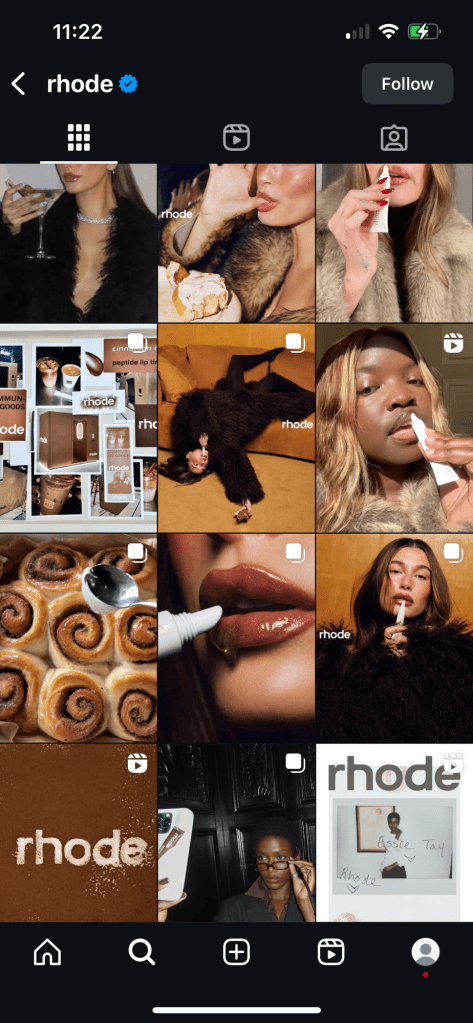
First up is the marketing genius behind skincare lovers’ fave — Rhode Beauty, created by Hailey Bieber. What sets Rhode apart from other beauty brands is their authentic voice and genuine connection with followers.

Check out these two screenshots from their Instagram launch campaign for the Peppermint and Cinnamon lip balms. Their posts not only build hype but also spark real conversations — Rhode consistently engages with customers in the comments, showing solid interactivity. Plus, Hailey Bieber herself posts casual, behind-the-scenes content, which builds trust and authenticity.”

A+ to Rhode Beauty for staying relevant, engaged, and following netiquettes and building their social persona. They are acing the social media game, owning a big share in the market now.

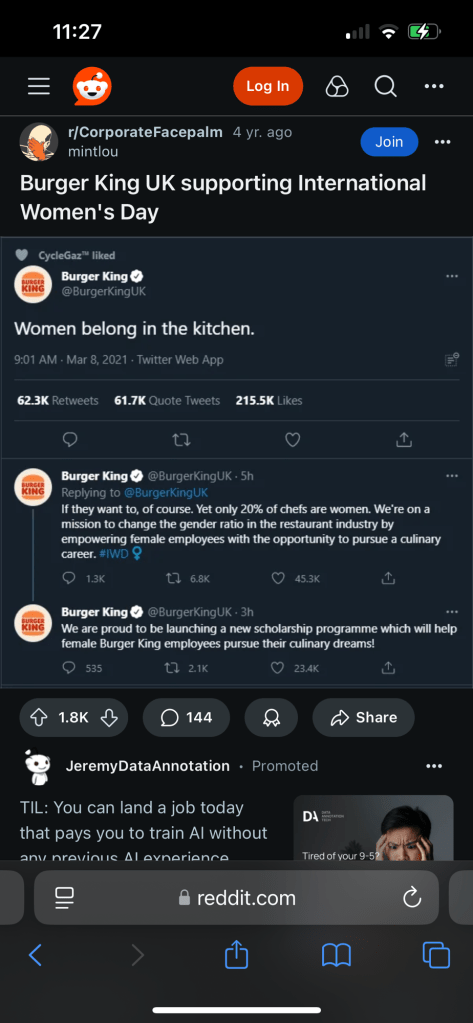
On the flip side, Burger King’s infamous Women’s Day tweet is a prime example of a netiquette fail. They posted, ‘Women belong in the kitchen,’ intending to promote a culinary scholarship for women — but the tone-deaf phrasing sparked backlash for sexism and insensitivity.

This misstep shows how risky social media can be if you don’t respect your audience.

Following is the example of the said instance.

One has to be really mindful and careful about what they post on the Internet, as in only a matter of seconds, a lot of controversies can fire up.

This is one small example of how serious netiquettes should be taken. Since, the social media is a messy and sensitive platform with people from different experiences, ethnicities, backgrounds, there should be a proper way of addressing and communicating with all.

https://www.usatoday.com/story/money/2021/03/08/burger-king-uk-under-fire-women-belong-kitchen-tweet/4627505001/

In today’s digital world, all I can say is, “mind your step, please and thank you.”

“I always feel like somebody’s watching me”

You ever wonder what it really means when you accept a cookie (not a literal cookie) but the pop up ones that you get on a site when you visit?

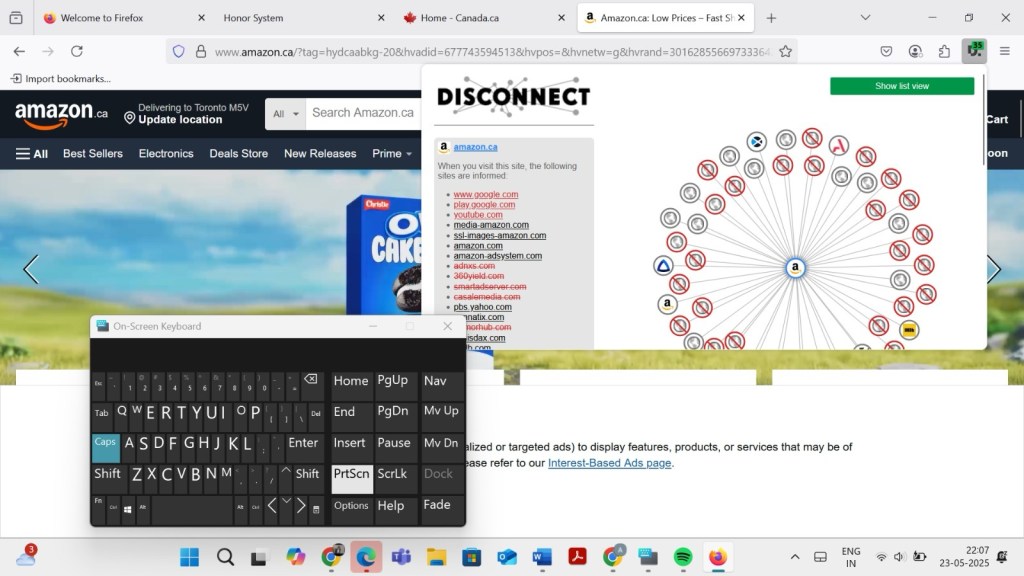
Yeah me, too. So I decided to see who is actually stalking us secretly when we surf online. As part of our assignment we were required to use ‘Disconnect’ to identify the number of trackers on each website. What I found out, was pretty shocking! SO. MANY. TRACKERS, just to look up online for a gym sweat pant?

I have statistical data backed up with screenshots to give you a rough estimate on the number of watchers on each site, who quite literally keep a watch on your every move.

The highest number being taken by…..????

….

Drumroll…

Amazon!

Yes, the A to Z shopping website that probably every person who has access to the internet has browsed. It has a whopping 35 trackers.

Here are some examples of the trackers I found on other websites:

  • Amazon- 35 trackers
  • Sephora- 21
  • Temu- 13
  • Toronto Public Library- 5
  • CBC- 19
  • The Guardian- 7
  • Bluesky -1
  • Tiktok– 6
  • CRA- 4

These are just some few numbers, and remember that the trackers change depending on the time spent, location, whether you’re logged in or not, and many factors.

Amazon was the most surprising with 35. However, atleast for platforms like Tiktok, Youtube or social sites I felt like the number would be higher, but it was not. Surprisingly, CRA- a government website also had a couple trackers which was not seen coming. News channels, of course, have a higher share of trackers too, owing to the ad driven nature and data collection for content.

Overall, crazy observation and insights, all thanks to the assignment and Disconnect, for showing us the reality of these data hungry sites.

Next time you click ‘Accept Cookies,’ just remember: there’s a whole squad watching.”